Al-Anon Family Group

The material presented here is not Al-Anon Conference Approved Literature. It is a method to exchange information, ideas, feelings, problems and solutions on a personal level.

Members Login
Username 
 
Password 
    Remember Me  
Post Info TOPIC: Why Arabic Reading Skills Matter When Studying Quran


Member

Status: Offline
Posts: 6
Date:
Why Arabic Reading Skills Matter When Studying Quran


whatsapp-image-2026-05-21-at-10-27-33-pm-1-1b9348.webp Why Arabic Reading Skills Matter When Studying Quran

A student can know the Arabic alphabet and still struggle to read a line of Quran. Another may read the text aloud reasonably well without understanding the vocabulary. These are different problems, and they call for different kinds of study.

For beginners, the first task is often quite narrow: learning to recognize Arabic letters in their different forms, join them correctly, and read words with the vowel marks used in Quranic text. None of that requires fluency in spoken Arabic or advanced grammar before Quran reading can begin.

Reading Quran Requires More Than Knowing the Alphabet

Arabic letters change shape depending on where they appear in a word. Recognizing on its own is one thing. Identifying it quickly when it is joined to other letters is another.

Then come the marks that affect how a word is read: short vowels, sukoon, shaddah and signs connected with lengthening. A beginner who has memorized the names of the letters may therefore still need considerable practice before reading connected Arabic comfortably.

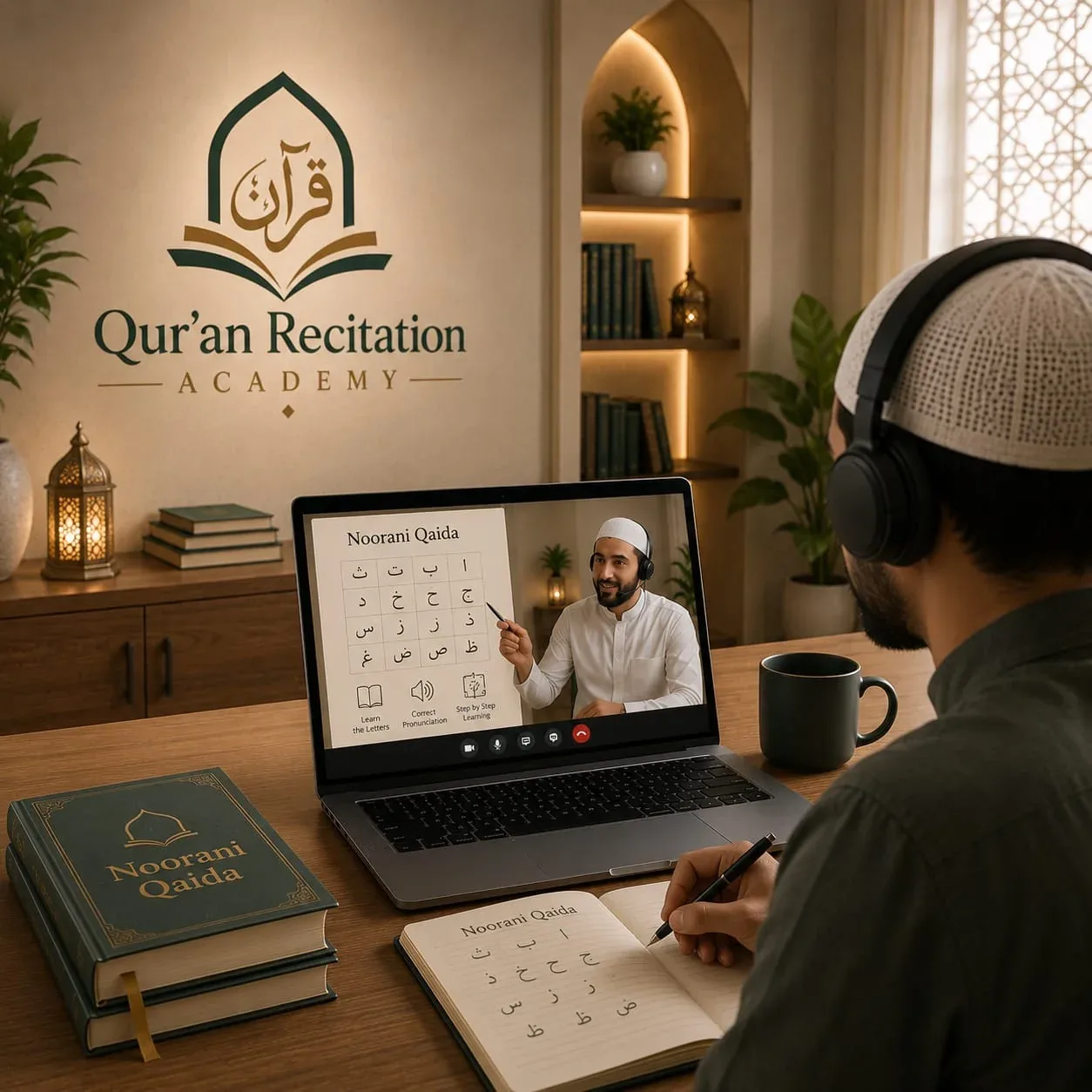
This is the purpose of introductory reading methods such as Noorani Qaida. Lessons typically move from individual letters toward joined forms and increasingly complete words. The subject is reading the script, not learning how to hold a conversation in Arabic.

That difference is worth keeping clear. A student does not need to finish a general Arabic course before beginning to read Quran.

Reading a Word and Understanding It Are Separate Skills

Someone may be able to pronounce a Quranic word from the page yet not know its meaning. That does not mean the reading instruction has failed. It means the student has reached a different area of study.

Arabic as a language includes vocabulary, grammar, morphology, sentence structure, listening, writing and, depending on the course, speaking. A student interested specifically in Quranic Arabic may concentrate more heavily on vocabulary and structures encountered in Quranic text.

That work goes beyond decoding the script.

A learner who already reads but wants to study the language more closely might add an Arabic course without giving up regular Quran reading. Someone at an earlier stage may be better served by putting most of the study time into basic reading first.

Knowing more Arabic can make familiar words and grammatical patterns easier to recognize. It should not, however, be confused with having the broader knowledge needed to interpret Quranic passages independently.

Work Out Which Problem You Actually Have

Course names are not always enough to tell a learner where to begin.

Consider three students. One cannot reliably identify joined Arabic letters. Another reads words but often hesitates over vowel marks. A third reads the Quran comfortably and now wants to study vocabulary and grammar.

Putting all three into the same type of Arabic class would make little sense.

This becomes especially relevant when searching to learn Arabic online. A course may focus on conversation or general grammar, while the student's immediate problem is simply reading Arabic letters for Quran. The reverse can happen too: someone who already reads fluently may gain little from repeating an alphabet-based beginner course.

A useful question before enrolling is: what should I be able to do after the first stage of this course?

For introductory Quran reading, the answer should relate to specific reading tasks. A broader Arabic program should describe language objectives such as vocabulary, grammar or comprehension.

The Two Subjects Can Be Studied Together

Reading instruction and Arabic-language study do not need to be separated forever. They simply need to remain distinct enough that the student knows what each lesson is trying to accomplish.

Some learners establish their reading first and add language study later. Others study both at once, particularly when they already have some familiarity with the script.

For students who want both options in one place, Al Quran Recitation Academy is one provider with courses covering introductory Quran reading as well as broader Arabic study.

The practical distinction is simple. Learning to read Arabic gives a beginner access to the written text of the Quran. Studying Arabic vocabulary and grammar addresses a different question: what does the language itself mean and how is it constructed?


__________________
Page 1 of 1  sorted by
 
Quick Reply

Please log in to post quick replies.